When Your Neck Isn’t Just a Pain — It’s the Root of Everything
At Breiner Whole-Body Health Center, we meet many patients whose symptoms seem unrelated at first glance: dizziness, brain fog, migraines, fatigue, muscle weakness, anxiety. But a deeper evaluation often reveals a hidden structural issue at the base of the skull — craniocervical instability, or CCI.
If you’ve been searching for answers from neurologists, chiropractors, or specialists without lasting relief, it may be worth considering whether instability in your upper neck is affecting your entire nervous system. There are effective, non-surgical options. We provide personalized, integrative Craniocervical Instability Treatment for patients across Fairfield County — including Fairfield, Stamford, Norwalk, and Greenwich — and for those traveling from New York. Our goal is simple: to help you stabilize your neck, brainstem, and nervous system safely, naturally, and without surgery.
Below, we explore what CCI is, how to recognize it, and how we use regenerative therapies like AltPoint PNE, TruDose, and non-surgical ligament repair to restore function.
What Is Craniocervical Instability?
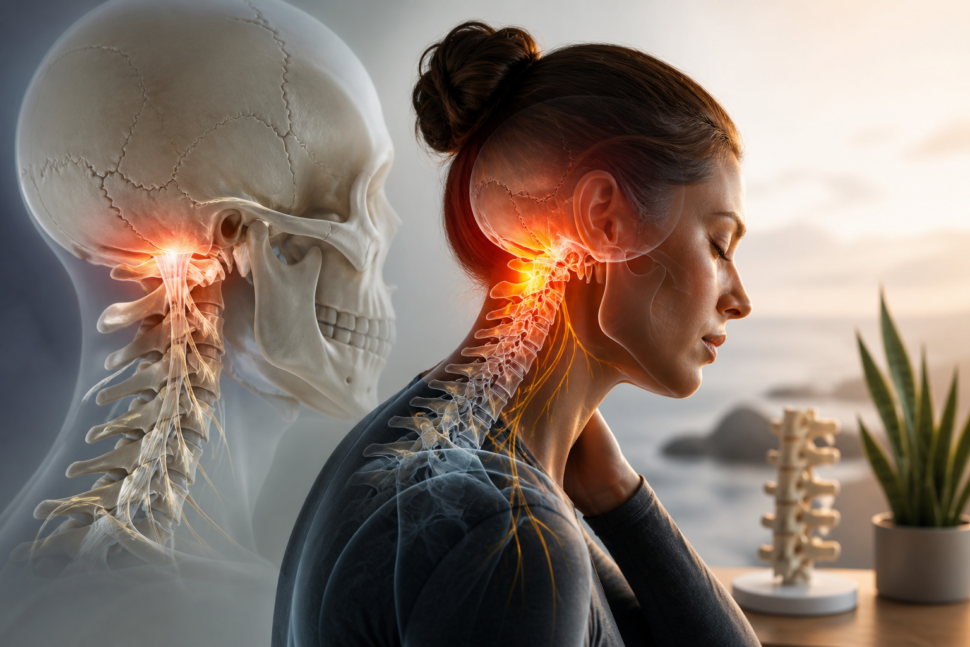
Craniocervical instability refers to excessive motion or laxity at the junction between the skull and the top two vertebrae in the neck (the atlas and axis). This area — the craniovertebral junction — helps protect the brainstem, spinal cord, vagus nerve, and key blood vessels.
When the ligaments here become weakened, damaged, or overstretched through trauma, hypermobility, or inflammation, they lose their ability to stabilize the head and neck, which can produce a wide cascade of symptoms. We frequently see patients with CCI who were previously evaluated for anxiety, fibromyalgia, chronic fatigue syndrome, POTS, or MS — and with the right assessment, we can often trace those symptoms back to instability at the upper cervical spine.
Common Signs and Symptoms of CCI
Because CCI affects such a vital area — the brainstem, cranial nerves, and upper spinal cord — symptoms can be widespread, variable, and easily misattributed. Many patients spend years chasing symptom relief without discovering that ligament laxity in the upper cervical spine was a contributing cause. Commonly reported symptoms include:
- Headaches, especially at the base of the skull or radiating toward the forehead
- Visual disturbances, light sensitivity, or blurred vision
- Neck pain, tightness, or a sensation of heaviness in the head
- Dizziness, balance problems, or a feeling that the ground is moving
- Tinnitus (ringing in the ears) or sound sensitivity
- Fatigue, brain fog, or cognitive “slowdown”
- Heart palpitations, blood pressure fluctuations, or faintness when standing
- Difficulty swallowing, throat tightness, or slurred speech
- Jaw pain, TMJ dysfunction, or facial tension
- Tingling, numbness, or weakness in the arms or legs
We also frequently identify cervicogenic headache — a type triggered when instability irritates cervical nerve roots. Many patients describe symptoms that worsen with upright posture or activity, a possible indicator of mechanical instability. If you’ve been told your symptoms are “all in your head,” or you’re juggling multiple diagnoses that don’t explain the full picture, it may be worth exploring whether CCI is involved.
What Causes Craniocervical Instability?
CCI can result from a number of underlying conditions or events. The most common we see include:
- Whiplash injuries or concussion
- Repetitive strain (e.g., “tech neck” or poor posture)
- Ehlers-Danlos syndrome or generalized ligamentous laxity
- Rheumatoid arthritis or chronic inflammation
- Chiari malformation or structural abnormalities
- Previous neck surgery or trauma
Many patients don’t recall a specific injury; instability can develop slowly over time due to lifestyle, undiagnosed connective tissue disorders, or chronic inflammation. We take all of this into account when designing your personalized plan.
Diagnosing CCI: Our Approach
Diagnosing craniocervical instability isn’t always straightforward — imaging alone often misses functional instability that only appears during certain movements or postures. That’s why we take a multimodal approach:
- Detailed structural and neurological exams
- Upright imaging when necessary
- Assessment of joint proprioception and balance
- Vagal nerve testing and dysautonomia evaluation
- Review of symptom triggers and movement patterns
This lets us identify not only whether CCI is present, but how it may be affecting your autonomic nervous system, motor control, and quality of life. According to the National Institutes of Health (NIH), conditions involving cervical ligament laxity are underdiagnosed and often misattributed to unrelated neurological or psychological causes.
Non-Surgical Craniocervical Instability Solutions
For years, patients with CCI were often told surgery was their only option — but surgery carries significant risks. Thanks to advances in regenerative medicine and neuromuscular therapy, we can offer non-surgical solutions tailored to your anatomy:
1. AltPoint PNE Therapy
Our signature therapy uses Percutaneous Needle Electrolysis to target dysfunctional ligaments and reawaken proprioceptive feedback loops, improving neuromuscular coordination and helping reset the body’s stability response.
2. Non-Surgical Ligament Repair
By applying microcurrent stimulation to damaged ligaments, we aim to trigger fibroblast activation and collagen remodeling, helping the ligaments regain strength and elasticity.
3. TruDose Regenerative Therapy
We may also recommend TruDose or Platelet-Rich Plasma Therapy to support tissue regeneration and healing.
4. IV Therapy for Chronic Conditions
Patients with CCI often experience systemic inflammation. Our IV protocols aim to support cellular energy, reduce oxidative stress, and enhance healing.
Together, these therapies form the backbone of our non-surgical strategy for stabilizing the head and neck.
How We Use Regenerative Medicine for Ligamentous Instability in the Neck
Ligamentous instability in the neck refers to weakened or overstretched connective tissue supporting the upper cervical spine. When ligaments can no longer do their job, the head feels unstable, muscles overcompensate, and the nervous system can become reactive and dysregulated.
We approach ligament healing through regenerative therapies that aim to stimulate collagen production, increase circulation, and restore the natural feedback loop between joint and brain. This includes Percutaneous Needle Electrolysis to help retrain neuromuscular patterns and non-surgical ligament repair using gentle electrostimulation targeting the specific ligamentous attachments involved. In many cases we integrate TruDose or Platelet-Rich Plasma Therapy, supported by IV Therapy that optimizes nutrient delivery to joints and tissues.
The aim is greater structural integrity, reduced compensatory muscle tension, improved blood flow to the brainstem, and a calmer nervous system. Healing ligamentous instability is a process — but with the right tools and guidance, the body is often capable of meaningful recovery.
Cervicogenic Headache and CCI: Understanding the Connection
Many patients with craniocervical instability experience chronic headaches that don’t respond to standard treatments. These are often cervicogenic headaches, meaning the pain originates from structures in the neck — typically the upper cervical joints or ligaments — and radiates into the head, face, or jaw.
In these cases, the root cause often lies in microinstability of the craniovertebral junction, where constant micro-movements irritate pain-sensitive structures including the dura, vertebral arteries, and vagus nerve. Patients may describe pain that starts at the base of the skull and shoots upward, worsens with upright posture, or comes with nausea, blurry vision, or imbalance.
We focus on addressing the cause, not just the symptoms — using a personalized combination of Craniocervical Instability Treatment, non-surgical ligament repair, and AltPoint PNE Therapy to help restore cervical stability and calm the nervous system. Research indexed through PubMed and the CDC supports the link between cervical instability and central sensitization, where the nervous system becomes stuck in a pain loop. By restoring structure, we aim to help the brain feel safe again so the pain can begin to unwind.
Research, Results, and Hope
The science behind craniocervical instability treatment continues to grow, reinforcing what many patients have long sensed: when the upper neck is unstable, everything downstream can be affected — from cognitive performance and vision to digestion, heart rate, and posture.
Our treatments are informed by research from the NIH and PubMed, combined with a human-first philosophy that sees you as more than your scans or symptoms. Many patients come to us after being dismissed, misdiagnosed, or offered risky surgery. We listen, investigate, and partner with you to build a non-invasive plan that supports long-term recovery.
Outcomes we work toward include improvements in:
- Neck stability and range of motion
- Neurological symptoms
- Vagal tone and heart-rate variability
- Headache frequency and severity
- Energy, mood, and cognitive clarity
We believe the body is capable of healing when given the right support, and we’re here to provide the tools, science, and care to help you get there.
Ready to Stabilize, Heal, and Move Forward?
You don’t have to keep guessing what’s wrong. If you’ve been told your tests are “normal” but you still feel off, in pain, or disconnected from your energy, you’re not alone — many of our patients walked a long road through misdiagnosis and uncertainty before discovering that craniocervical instability was the missing link.
Our integrative approach is designed to identify root causes, restore stability, and support your healing with precision and compassion. Whether you live in Fairfield or you’re traveling from Stamford, Norwalk, Greenwich, or New York, our team is here to help — without surgery or long-term medications, using non-invasive therapies including AltPoint PNE Therapy, non-surgical ligament repair, and supportive regenerative medicine tailored to your needs.
If you’re ready to explore a personalized, science-informed path forward, book your consultation with us today. We’ll meet you with answers, a plan, and the belief that healing is possible.